Sunday, November 27, 2016

Buried Nephite City and BOM Elephants


Off the shore of Lake Michigan (Book of Mormon West Sea) Grand Traverse Bay buried under 40 feet of water are petroglyphs. These petroglyphs are most likely the remains of a Nephite city caused by the calamities just before Christ visit to the Nephite people.

In 3Ne chapter 8 it states that cities were sunk the city of Moroni being sunk into the depths of the sea. These petroglyphs found in Lake Michigan also known as the west sea is evidence of a Nephite city being sunk into the depths of the sea.

One of the boulder petroglyphs found in Lake Michigan has a depiction of a mastodon. As described “Viewed together, they suggest the outlines of a mastodon-like back, hump, head, trunk, tusk, triangular shaped ear and parts of legs…”

These descriptions fit extremely well with the Book of Mormon. First of all the Jaredites mention that they had elephants. The assumption here is that mastodons are the elephants mentioned in the Book of Mormon. Some scientist believes mastodons went extinct due to human predation around 10000BC predating the Book of Mormon. Historical accounts show that not all mastodons were extinct at that time. Thomas Jefferson was told that mastodons inhabited the Great Lakes area. David Cusic when living with the Iroquois was told of a large animal that ransacked their village that was attributed as a Mammoth. Early settlers found Indian smoke pipes in the shape of Mastodons/elephants.

The petroglyphs found in Lake Michigan are described as being Stonehenge like.There is no evidence that Neolithic hunters and gatherers were capable of moving boulders to make Stonehenge 10000 years ago. The Stonehenge description of the petroglyphs is  a very fitting description. Haplo group x is a founding dna marker found in Native Americans with its highest concentration found in the Great Lakes area. Besides being found in the middle east an Israel it also found in Scotland with the highest concentrations of Europe found in the Orkney Island above Scotland.

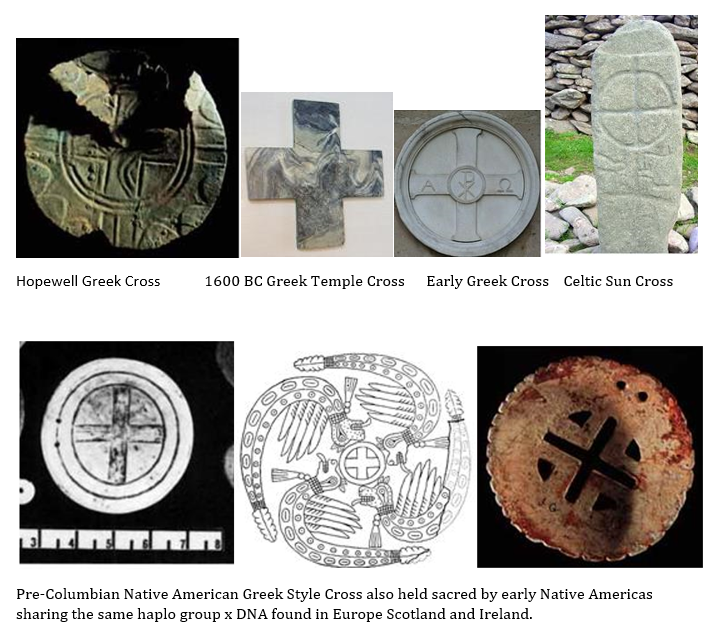
The Greek Cross (sun cross) was a very important religious not only to the Hopewell Indians and the Mississippian Indian culture but also to the Celts of Europe. Each of them tied not only the haplo group x dna maker but through culture.

Petroglyphs in Lake Michigan found via sonar

Hopewell and Adena elephant pipe depictions are from The Mound Builders Their Work and Relics by Stephen D Peet PhD.


Cultural Native American Link to Europe and the Old World


Haplo Group X DNA distribution. The explanation of how Native American Haplo Group x DNA arrived in the Great Lakes area and Hebrew customs artifacts and language is best explained by the Book of Mormon and Bible not the Bering (Barren) ice bridge theory.
See Links
Book of Mormon DNA
Native American Hebrew and old world links.


Thursday, November 17, 2016

City of Bountiful Artifacts ?


When Michigan began to be settled in the 19th and 18th century by early American farmers they found thousands of clay, copper and slate artifacts discovered throughout the lower peninsula of Michigan  The Michigan relics are copper clay and slate artifacts that have hieroglyphic and cuneiform and unknown characters on them. The artifacts also have bible story depictions, that include depictions of Jesus Christ.

Shown below are pictures of just a few of the thousands of Michigan Relic artifacts.


Temples

The Michigan Relics depict temple like structures.


Did Native Americans build hebrew like temples? Historical acounts show that they did. The conquistadors and settlers found that Native Americans built lavish temples.

Their tem­ples were built with much skill and labor. They made very beau­ti­ful things with all kinds of mate­ri­als, such as gold, sil­ver, stones, wood, fab­rics, feath­ers, and many other things in which they made their skill appear.”
“A remark­able tem­ple was sit­u­ated in the town of Tal­maco, upon the Savan­nah River, three miles dis­tant from Cuti­fatchique, near Sil­ver Bluff. It was more than one hun­dred feet in length, and fifty feet in width. The walls were high in pro­por­tion, and the roof steep and cov­ered with mats of split cane, inter­wo­ven so com­pactly that they resem­bled the rush car­pet­ing of the Moors.”
(Jones, The Amer­i­can Nat­u­ral­ist, Vol 3 1869)

Henri de Tonto, who trav­elled with de la Salle and wrote an exten­sive report, thought them most “pol­ished” peo­ple he had seen. As with the Illi­nois and Natchez, they main­tained a sacred fire (similar to Hebrew temples eternal flame) that was never allowed to go out in their major Tem­ple… an elab­o­rate palace with dec­o­rated walls ten feet high.”
(A Cul­tural His­tory of the Atlantic World, 1250–1820, by John K. Thornton)

Christ Visit to the American Continent


 (Iro­quois Legend)

The vis­i­tor appeared very old man; he appeared among the peo­ple for a while; he taught them many things; how to respect their deceased friends, and to love their rela­tions and he informed the peo­ple that the whites beyond the great water had killed their Maker, but he rose again.”
(Ancient History of the Six Nations 1838 pg. 31)

Christ visit was to the City of Bountiful located in Michigan.


The teaching and spread of the gospel

In this Michigan Relic depiction it appears the teaching of the gospel.


The teaching and spread of the gospel is supported by Mik Maq traditional accounts.

(About Gaspesian/Mik Maq Indians)

“They hold, further, that it could well have been a fact that these
individuals were instructed in the sacred mysteries of our holy
Religion, and that they had even a knowledge and the use of
letters, since, in the establishment of colonies, it is customary
to send there men who are alike learned and pious, in order
that they may teach to the peoples, along with purely
human knowledge, the most solid maxims of Christian wisdom
and piety. Nobody, however, having followed them in these
glorious employments, the knowledge which they had of the
true God, of letters, and of their origin, was thus gradually
lost and effaced from the minds of their unfortunate posterity
by the lapse of time.”

(New Relations of Gaspesia 1680 pg86)


The Serpent Staff


Nephi taught from the Old Testament and about the children of Israel being afflicted by fiery flying serpents. When bitten by one of these serpents the only way to be healed was to look upon a serpent staff. A serpent staff is represented on this artifact


Copper ax (Michigan Historical Museum)


Archeologist believe these artifacts are fake because of biblical depictions. In my unprofessional opinion these are artifacts from a Nephite city, Bountiful.

Alma Chapter 22
http://bookofmormonevidence.blogspot.com/2016/09/six-sea-model-alma-chapter-22-bom-map.html

See link for archeological evidence for wall built to defend Bountiful and other Nephite cities.
http://bookofmormonevidence.blogspot.com/2016/09/archeological-evidence-of-fortified.html

Native American and Children of Israel flying serpents and the serpent staff.
http://bookofmormonevidence.blogspot.com/2016/11/children-of-israel-and-native-american.html

Christ visit to Native American Mik Maq Indians
http://bookofmormonevidence.blogspot.com/2016/10/mik-maq-nephites-and-christ-visit.html

Native American Hebrew like temples
http://bookofmormonevidence.blogspot.com/2016/09/native-american-hebrew-like-temples.html

Native American ties to Hebrew
http://bookofmormonevidence.blogspot.com/2016/09/native-american-hebrew-language.html

Native American ties to the Book of Mormon
http://bookofmormonevidence.blogspot.com/2016/09/native-american-ties-to-book-of-mormon.html

Hopewell (Nephite) Breastplates and Woven Cloth
http://bookofmormonevidence.blogspot.com/2016/09/book-of-mormon-breastplates-and-jewelry.html


Friday, November 11, 2016

Israelites and Native American Fiery Flying Serpents


Fiery Flying Serpent


Nephi (1NE 17:41) references the Old Testament record of the Children of Israel being punished by by Fiery Flying serpents. Having been bit the only way to survive was to look upon a serpent staff. The consequence of not doing so was death.


Pre Columbian Mississippian artifacts and Native American legend help confirm the teaching of Nephi about the Children of Israel and the fiery serpents.


According to Cherokee legend if Uktena a fiery horned serpent, is not appeased the serpent will fly around in the shape of fire and attack tribe members.


"Every seven days he feeds it with the blood of small game, rubbing the blood all over the crystal as soon as the animal has been killed. Twice a year it must have the blood of a deer or other large animal. Should he forget to feed it at the proper time it would come out of its cave in a shape of fire and fly through the air to slake its thirst with the lifeblood of the conjurer or some one of his people. He may save himself from this danger by telling it, when he puts it away, that he will not need it again for a long time. It will then go quietly to sleep and feel no hunger until it is again brought forth to be consulted. Then it must be fed again with blood before it is used. "


Mississippian depictions of flying serpents:


This depiction coincides with the sacred Greek Cross:


"Those who know say the Uktena is a great snake…with horns on its head, and a bright blazing crest like a diamond on its forehead, and scales glowing like sparks of fire." (Mooney, James. Myths of the Cherokee. US Bureau of American Ethnology, 1897-8 Annual Report, 1902)